
Awesome Trading Agents is live. We Built the Open Source Map of AI Trading Agents.
Inside the curated catalogue from LLMQuant that charts every serious project where language models are no longer predicting prices but running the entire investment workflow.

If you have spent any time in the overlap between large language models and financial markets over the past year, you have probably been drowning in jargon. AI Trading Agents. MCP. SKILL.md. Claude Code. AI hedge funds. Polymarket. Kalshi. The vocabulary multiplies faster than anyone can keep up, but underneath the noise sits one quietly seismic shift. Large language models are no longer asked to forecast tomorrow’s close. They are being handed the entire investment workflow, from reading filings to placing orders, and they are starting to do it well enough that serious money is paying attention.
The LLMQuant community has just released the Awesome Trading Agents, a curated map of this fast moving territory, and it is worth a careful walk through. Unlike the older catalogues such as awesome-ai-in-finance or awesome-quant, this list deliberately ignores classical quantitative libraries, time series models, and reinforcement learning bots. It tracks one specific phenomenon: what happens when the language model itself becomes the decision maker. The catalogue currently spans roughly forty active repositories organised into three layers, and that three layer architecture is itself the most important takeaway.
The Three Layer Stack That Quietly Became an Industry Standard
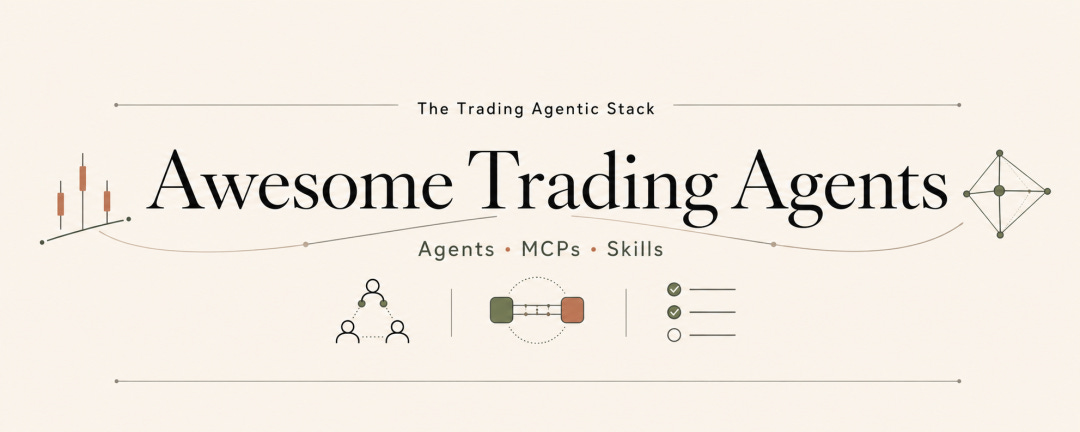
In 2024 the architecture of an AI trading system was a mess of bespoke scripts. By the end of 2025, after Anthropic shipped its Agent Skills standard and brokers including Alpaca, Kraken, and OKX rolled out official Model Context Protocol servers, a clean three layer stack has emerged. Agents sit at the top as the decision layer, where the model reads research, debates positions, and outputs buy, sell, or hold. MCPs form the tool layer, a sort of USB-C standard that lets agents reach out to market data, brokers, and backtesters through a uniform interface. Skills, written as SKILL.md files, are the workflow layer, capturing reusable research procedures that any compatible agent can invoke. This separation matters because it turns one off prompts into composable infrastructure, and infrastructure is what makes capital allocators take a technology seriously.

The Decision Layer: From Boardroom Debates to One Person Wall Streets
The agent layer has split into two philosophical camps. The multi agent school, anchored by TauricResearch’s TradingAgents project built on LangGraph, seats analysts, bullish and bearish researchers, traders, risk officers, and portfolio managers around a virtual table and lets them argue until a decision emerges. The approach has spawned a small ecosystem of forks, including a Chinese A share localisation by hsliuping that integrates Tushare and AkShare, KylinMountain’s fifteen agent A share rewrite with full visualisation and Docker deployment, and Tomortec’s crypto adaptation. HKUDS has gone further with AI-Trader, a platform where any agent such as Claude Code, Codex, or Cursor can register through a SKILL.md file and execute live trades through AI4trade.ai. AI4Finance Foundation maintains the academically oriented FinRobot, while AutoHedge from The Swarm Corporation promises to spin up an autonomous hedge fund in minutes, and FinStep AI’s ContestTrade introduces a clever twist by making agents compete internally before a single view is promoted to the final decision.
The opposing camp argues that committees do not generate alpha, individuals do. Virattt’s ai-hedge-fund, one of the most forked LLM trading repositories on GitHub, lets analyst personas modelled on Buffett, Munger, and Cathie Wood pitch ideas to a portfolio manager who makes the call. TraderAlice’s OpenAlice brands itself as your one person Wall Street, built on the Claude Agent SDK with a Trading-as-Git approval workflow and a unified trading account spanning multiple asset classes. Atlas-gic from chrisworsey55 takes yet another angle, focusing on a single self improving agent that refines its own strategies rather than convening debates.
The most entertaining slice of the agent layer is the real money tournament. LuckyOne7777’s LLM Trading Lab ran a six month forward only experiment in which ChatGPT managed a real US small cap portfolio under strict predefined rules, documented in a forty page evaluation paper. The nof1.ai Alpha Arena ecosystem has spawned at least four open source spinoffs in which DeepSeek, Qwen3-Max, and other frontier models trade live against each other to settle the question of which model actually has market sense. Prediction markets are a quietly underrated frontier here, since contracts on Polymarket and Kalshi are essentially natural language events priced as probabilities, a format that suits language models far better than equities. Projects including ryanfrigo’s Grok-4 driven Kalshi bot with a five gate risk engine and YichengYang-Ethan’s oracle3 with cross venue arbitrage across Kalshi, Polymarket, and Solana are pushing this idea hard.
The Tool Layer: Why MCPs Became the USB-C of Finance
If agents are the brain, MCPs are the cabling that lets the brain feel the market. The 2025 explosion happened because every major broker realised that without an official MCP, third party integrations would proliferate uncontrolled. Alpaca’s official server has effectively become the default companion to Claude Code Skill packages, supporting paper and live trading across stocks, ETFs, options, and crypto. Kraken’s AI native CLI ships with fifty SKILL.md packages covering crypto, tokenised stocks, FX, and derivatives. OKX’s agent trade kit covers spot, perpetuals, futures, options, and grid bots. Korea Investment Securities, Interactive Brokers through community wrappers, and MetaTrader 5 are all reachable through MCPs, which means that within a single year retail FX traders, professional prime brokerage clients, and Korean equity desks all gained access to the same agent tooling layer. On the data side, Financial Datasets, FinanceMCP with its Tushare and Binance coverage, the SEC EDGAR MCP for filings, and the eighty four source OpenNews aggregator round out the picture.

The Workflow Layer: Skills as Reusable Research Capital
Skills are the youngest and fastest growing layer of the stack. Tradermonty’s claude-trading-skills delivers a comprehensive equity research pack covering market breadth, regime detection, options flow, and Alpaca portfolio management. The Awesome-finance-skills suite from RKiding offers a full pipeline from news ingestion through sentiment, signals, and visual reporting. OKX has open sourced onchain skills for wallet management and DEX execution, while marketcalls has packaged vectorbt backtesting workflows so that any Claude Code instance can run optimisation sweeps without bespoke setup.
What This Map Actually Tells Us
Three structural shifts deserve emphasis. First, the centre of gravity has moved from price prediction to process organisation. The interesting question is no longer whether a model can guess tomorrow’s direction, but whether it can reliably gather evidence, stress test assumptions, call the right tool, and document its reasoning. Second, tool connectivity has become the binding constraint. An agent without market data, filings, order books, and a backtester is a chatbot with opinions, and MCP has made the difference between toy and production. Third, durable value increasingly accrues to reusable workflows rather than clever prompts. A good prompt solves one problem, while a good Skill turns a category of problems into a repeatable asset, and a good agent system stitches data, tools, workflows, and risk controls into something that can be audited and improved.
None of this is investment advice, and none of these systems have proven themselves across a full market cycle. But the map is real, the code is open, and the infrastructure is consolidating faster than most market participants realise. If you build, research, or trade, this is the moment to start reading the territory rather than waiting for it to settle.