
Bridgewater’s Latest 13F in Seconds: How Claude Code and GPT Codex Are Turning Raw SEC Filings Into Smart Money Research
From SEC Filing Chaos to an Instant Hedge Fund Brief

Every quarter, once new 13F filings hit the SEC database, the market starts asking the same question again: What are the world’s top hedge funds buying?
For years, answering that question meant doing a surprisingly manual workflow. Analysts had to search for the correct manager entity and CIK, pull the latest SEC filing, parse the holdings table, rank positions, calculate quarter-over-quarter changes, compare historical filings, then finally turn everything into something readable.
That process is tedious even for professional buy side researchers. But AI Agents are starting to change the workflow entirely.
Instead of discussing abstract “AI for finance” concepts, let’s look at a concrete example. We used Claude Code and GPT Codex together with the LLMQuant Data MCP stack to analyze Bridgewater Associates’ latest 13F filing and automatically generate a compact Smart Money Brief from raw SEC data.
The result is not just a holdings table. It becomes a readable institutional positioning narrative.
What Bridgewater’s Latest 13F Actually Looks Like
Bridgewater Associates’ latest disclosed 13F corresponds to the reporting period ending 2025-12-31, filed on 2026-02-13. The visible equity portfolio size was approximately $27.42B across 1,040 disclosed positions.
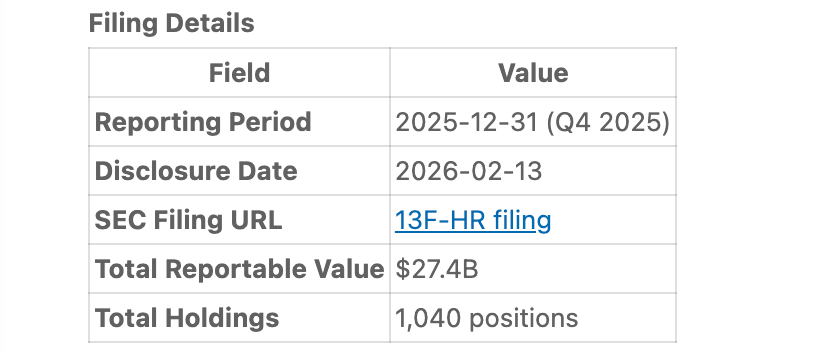
The most interesting part is not simply “which stocks they own.” The real signal comes from portfolio structure.
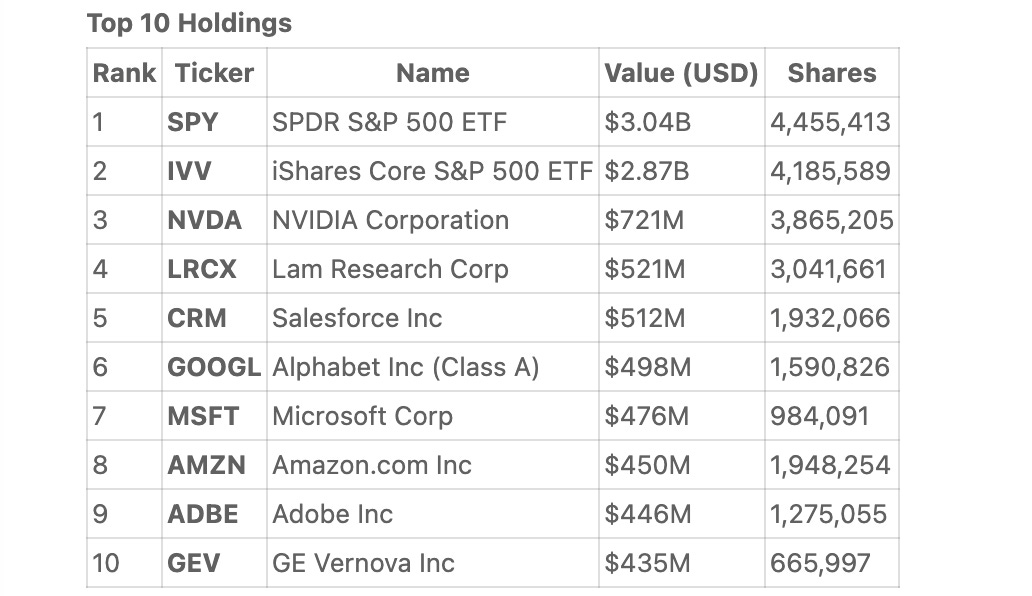
The top positions reveal four dominant exposure clusters.
First comes broad US equity beta through SPY and IVV. Together, the two S&P 500 ETFs account for more than 21% of the disclosed portfolio. This immediately tells us something important: Bridgewater is not expressing its portfolio primarily through concentrated stock picking. The core visible exposure remains systematic US market beta.
Then comes AI infrastructure and semiconductor capex exposure through NVIDIA and Lam Research. NVIDIA represents the AI compute layer. Lam Research represents semiconductor equipment and fabrication spending. Owning both simultaneously creates a much more specific macro technology expression than simply “buying tech.”
The third layer is enterprise software through Salesforce and Adobe. The final cluster combines mega cap technology platforms and electrification infrastructure through Alphabet, Microsoft, Amazon, and GE Vernova.
In one sentence, Bridgewater’s visible 13F structure currently looks like:
US equity beta plus AI infrastructure plus enterprise software plus electrification infrastructure.
That is far more informative than merely listing ticker symbols.
The ETF Exposure Is the Real Story
One of the most common mistakes retail investors make when reading hedge fund filings is over focusing on the flashy individual names.
People see NVIDIA in the top three and immediately conclude that “Bridgewater is aggressively bullish on AI.”
That interpretation misses the broader portfolio architecture.
The ETF positions dominate the portfolio by scale. SPY alone sits above $3B, while IVV is close to $2.9B. Every individual stock position is materially smaller.
This changes the interpretation entirely.
Bridgewater appears to be maintaining a large scale macro beta framework first, then layering thematic AI and infrastructure exposures on top of that base. In other words, the individual stock positions look more like thematic overlays than the core engine of the disclosed portfolio.
That distinction is critical in institutional portfolio analysis. A professional allocator does not just ask “what stock did they buy.” They ask: What role does each position play inside the total portfolio construction?
The More Interesting Signal Comes From the Changes
A single quarter only tells you what exists today. The real insight comes from tracking how institutional positioning evolves over time.
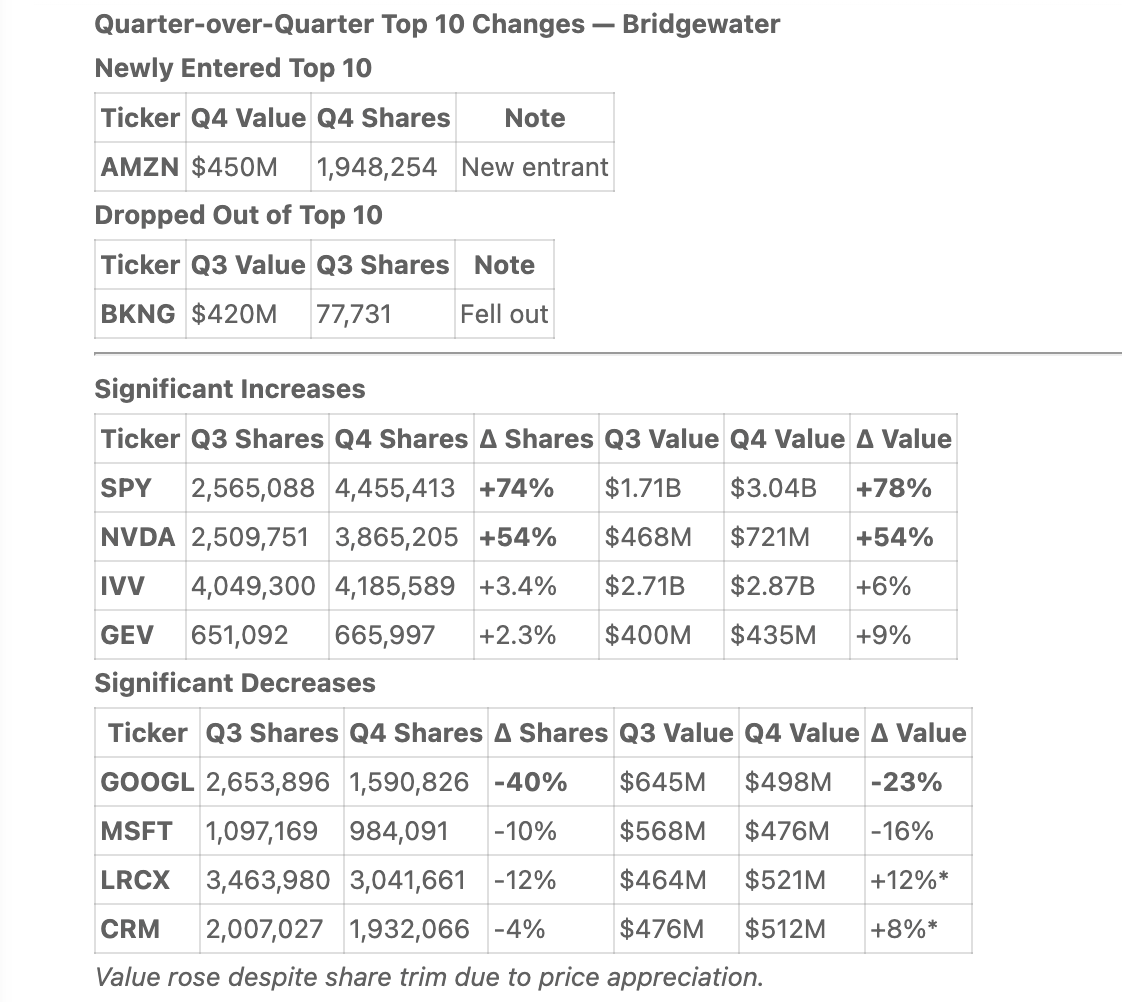
Looking across recent quarters, several structural shifts become visible.
SPY and IVV have remained persistent core holdings over multiple periods. That persistence matters. It suggests these ETFs are not tactical trades but long duration core exposure vehicles inside the visible US equity book.
Meanwhile, IEMG gradually faded from the top holdings list. Earlier quarters still showed meaningful emerging market ETF exposure. By late 2025, the visible core had rotated more decisively toward US large cap and AI related assets.
The newest and clearest signal is the strengthening AI infrastructure tilt.
NVIDIA increased sharply, while Lam Research simultaneously became more prominent. That combination matters because it captures two separate layers of the AI buildout cycle: NVIDIA represents compute demand. Lam Research represents semiconductor manufacturing capacity expansion.
Holding both suggests exposure not only to AI software enthusiasm, but to the physical infrastructure required to sustain the AI cycle itself.
The quarter over quarter changes reinforce this interpretation further.
SPY shares increased roughly 74%. NVIDIA shares increased roughly 54%. Amazon newly entered the Top 10.
At the same time, Alphabet exposure was reduced significantly, while Microsoft and Lam Research saw moderate share reductions despite higher valuation gains from price appreciation.
The resulting pattern looks less like indiscriminate tech buying and more like active reallocation toward AI infrastructure concentration.
Why This Workflow Is Perfect for AI Agents
What makes 13F analysis interesting is not the complexity of any single calculation. The challenge is the workflow itself.
A researcher must Find the correct manager entity, Locate the latest valid filing, Extract holdings, Normalize position data, Calculate historical deltas, Compare multiple quarters, Generate visualizations, Write a readable investment summary, and Attach traceable source links.
None of those steps are individually difficult. Together, however, they consume enormous amounts of analyst time. This is exactly the kind of structured financial workflow that AI Agents are extremely good at automating.
Claude Code and GPT Codex are not valuable merely because they can “answer finance questions.” Their real value appears when they can execute repeatable institutional research workflows end to end.
That is the philosophy behind the LLMQuant Smart Money Skills system. The goal is to generate a complete institutional positioning brief that is readable, traceable, and immediately usable inside a research workflow.
From Raw Filing to Smart Money Brief
The workflow behind the hedge-fund-position-disclosure Skill is intentionally designed to feel simple from the user side. A user only needs to ask something like:
“Show me Bridgewater’s latest 13F holdings, compare with last quarter, summarize the key signals, and provide the SEC filing URL.”
The system then automatically Identifies the correct manager, Finds the latest valid filing, Pulls the holdings table, Ranks the largest positions, Calculates changes versus prior quarters, Detects recurring core holdings, Generates natural language analysis, Returns traceable SEC source links.
The important shift here is conceptual. Users are no longer interacting with raw filings directly. They are interacting with an AI research workflow. That distinction is the future of AI in investment research.
How to Try It Yourself Using Claude Code or Codex
The setup is intentionally lightweight.
After obtaining a free API token from the LLMQuant Data platform, users can connect the MCP directly into Claude Code or GPT Codex environments.
For Linux or macOS:
export LLMQUANT_API_KEY="your_api_key"

codex mcp add llmquant-data \
  --env LLMQUANT_API_KEY="$LLMQUANT_API_KEY" \
  -- npx -y @llmquant/data-mcp
For Windows PowerShell:
$env:LLMQUANT_API_KEY="your_api_key"

codex mcp add llmquant-data `
  --env LLMQUANT_API_KEY=$env:LLMQUANT_API_KEY `
  -- npx -y @llmquant/data-mcp
Once configured, users can directly ask:
“Use llmquant-data to analyze Bridgewater Associates’ latest 13F filing, list the top 10 holdings, compare changes versus last quarter, and summarize the portfolio structure.”
Instead of raw JSON, the system produces a structured institutional positioning brief.
Additional documentation is available at:
LLMQuant Data 13F API Documentation
The LLMQuant AI for Trading Ecosystem
LLMQuant is building a broader AI for Trading ecosystem designed around that workflow philosophy.
The stack currently includes:
LLMQuant Data for agent native financial data and research context.
LLMQuant MCP for direct integration with Claude Code, Codex, and AI Agents.
LLMQuant Skills for reusable financial research workflows.
Quant Wiki as an open bilingual quantitative finance knowledge base.
Quant Paper for AI driven research discovery and semantic paper search.
QuantMind, WallQuant, and Trader as next generation AI native research and trading tools.
The objective is to move AI in finance beyond fragmented point tools and toward a reusable institutional research operating system.
And institutional positioning analysis is only one piece of that transition.
Supported by LLMQuant Data.
Note: 13F filings only disclose partial US long equity positions. They do not include complete short exposure, futures, macro hedges, non US assets, or total portfolio risk. As a result, 13F analysis should be viewed as a smart money research entry point rather than a standalone trading signal.